










Deriving equations always have been a fascinating thing, due to current project requirement I recently started reading All of Statistics, in several chapters it omit some proofs which I'm going to outline here
The properties of conditional expectations.
First we lay down the definition of conditional expectations, if  and
and  are two random variables, then
![\[\EE(Y|X)=\int_{-\infty}^{\infty} y p(y|x) dy\]](https://sora.ink/wp-content/ql-cache/quicklatex.com-6b3af7e5526e6bc1919a6973058f4006_l3.png "Rendered by QuickLaTeX.com")
where 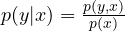 , as expected.
Notice that  is itself a function of
  , and itself can be functions, just like in normal expectations, we have
![\[ \EE(f(Y)|X)=\int_{-\infty}^\infty f(y)p(y|x)dy \]](https://sora.ink/wp-content/ql-cache/quicklatex.com-1d737e22b92ec3d5791eb38e7ab7b843_l3.png "Rendered by QuickLaTeX.com")
This is in fact a not so obvious result, because normally by definition of expectation we should have
![\[ \EE(f(Y)|X)=\int_{-\infty}^\infty f(y)p(f(y)|x)dy \]](https://sora.ink/wp-content/ql-cache/quicklatex.com-19b61d26fe2dbe888feb6c75c3f2261d_l3.png "Rendered by QuickLaTeX.com")
The proof I will omitted here but it's nonetheless named Law of unconscious statistician. Today we simply want to discuss some of its properties, which are easy and fun to derive while remaining not-so-trivial.
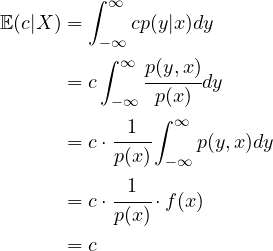
Theorem 1:  , where
  is a constant.
Proof:
(1) 
The author mentioned specifically about the regression problem, we use the function  to represent the result of the regression, and if is the random variable of the value on the de facto curve, then we can use the random variable
  to represent the error between the result of regression and the real curve, the books says that if we let
  , then
  . To show this, we need first to establish a lemma.
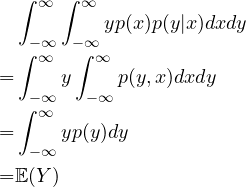
Lemma 1: 
Proof:
(2) 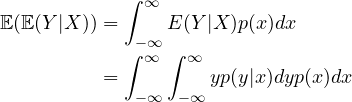
Notice in the first step, since is a function  of , thus when we expand the outer expectation we are actually expanding
  for some
  , thus we first integrating w.r.t. , and when we expand further the inner expectation itself, by definition it's an expectation of so we are integrating w.r.t.
  . Now, since
  itself is a constant w.r.t. , we can move it inside the inner integral, and furthermore, in statistics we often make some aggressive assumptions, for example, here we suppose that the iterated integral automatically satisfies the Fubini's theorem, thus we can exchange their order,
(3) 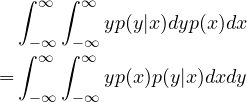
But notice that  is just
  ,and since is constant w.r.t. we can move it out of the inner integral, thus
(4) 
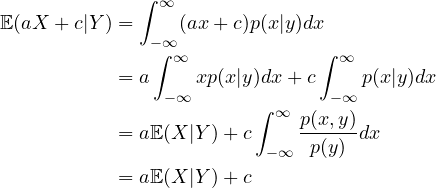
Having proven this, we need to prove another lemma, that is the linearity of conditional expectation, which the author also lacks in the original text
Lemma 2: 
Proof:
(5) 
Now we can prove that by noticing that
(6) 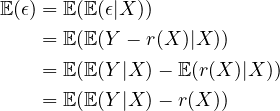
is by definition just  , so
, so  .
.
This means that the error between the result of regression and the actual curve can be modeled by a distribution whose expectation is  , in fact, you should have no surprise that normally the error
  is modeled by a normal distribution centered at , i.e.
 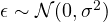 . That is, every curve regression problem can be modeled by the result of regression, plus a perturbation function
  that follows the normal distribution centered at .

Comments NOTHING